




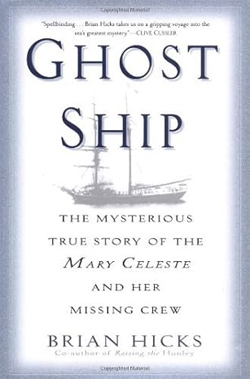
Ghost Ship: The Mysterious True Story of the Mary Celeste and Her Missing Crew by Brian Hicks is a modern book published in June 2004. It is well written and brings together a lot of historical information about the ship and the mystery.
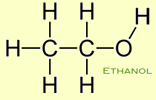
However, the author has popularised the idea that the cargo was methanol which he mentions in the Channel 5 documentary, "The Mystery of the Mary Celeste", as part of the "Revealed" series. This has later been corrected clarifying the cargo was potable ethanol, However the idea of methanol has spread around the internet, it is incorrect, and spoils an otherwise excellent book,
Until recently even Wikipedia described the cargo as 'denatured alcohol' which was wrong, but has been copied by authors and websites.
Hicks suggested the cargo was methanol (methyl alcohol) as part of his vapor-explosion theory to explain the crew's sudden abandonment.
His argument centered on the properties of methanol, which would have made the danger more acute than ethanol:
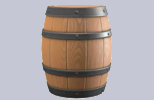
Increased Toxicity and Danger: Hicks reasoned that if the cargo were methanol or formaldehyde (a derivative of methanol), the leakage of 450 gallons from the nine empty barrels would have created noxious, toxic fumes in the closed hold. He wrote, "If 450 gallons of methanol or formaldehyde were poured into the ship's hold, it could have had serious physiological effects on the crew."
The "Vapor Alarm": This toxic vapor, combined with the extreme heat and calm weather (doldrums) the ship experienced, would have been an urgent health concern. Captain Briggs, facing a dangerous buildup of an industrial chemical vapor with no breeze to clear the air, may have been forced to evacuate the ship temporarily.
The Flawless Explosion: Hicks' theory aligns with the widely accepted idea that a flash fire or non-destructive explosion occurred. Experiments simulating an alcohol vapor explosion in a ship's hold show it could cause a spectacular, terrifying blast of flame that blows off the hatches but leaves no scorching or soot behind. The highly volatile nature of methanol or ethanol would support this event, which was frightening enough to make the crew panic and leave, but did not structurally damage the vessel.
Note on Cargo Type: While the historical records consistently refer to the cargo as "spirits" or "industrial alcohol" intended for fortifying wine (implying ethanol), Hicks' specific mention of methanol emphasizes a chemical that is both highly volatile and significantly more toxic than beverage-grade alcohol. This highlights the heightened sense of danger that would have driven an experienced captain like Briggs to abandon his vessel.
The availability of methanol in 1872 was limited to what could be produced through the destructive distillation of wood, a method that yielded methanol mixed with other compounds.
In 1872, pure, synthetic methanol was not widely available; it was primarily known as"wood alcohol" because of its source.
Therefore, while methanol was a known industrial chemical in 1872, it was not the widely available, inexpensive, and high-purity commodity it became decades later.
Methanol is significantly more toxic than ethanol, causing blindness, organ failure, and death because the body metabolizes it into dangerous substances like formaldehyde, whereas ethanol breaks down into acetaldehyde which has a characteristic sweet smell. Even small amounts of methanol (as little as 10ml) can be lethal. Anyone who used methanol or denatured alcohol containing it to fortify wine, would be out of business fast.
Recently in 2024 in Laos six tourists (Australian, Danish, UK, US) died in Vang Vieng after drinking tainted alcohol, highlighting the danger in backpacker hubs where tourists are poisoned by methanol from cheap, bootleg alcohol.
Foreign tourists had fallen victim to methanol poisoning after consuming incorrectly distilled Arak containing methanol in Bali, Lombok and Gili Islands. Among the local population, methanol poisoning is even more prevalent due to the widespread production of illicit liquor.
Dr Sella demonstrated a flash fire which did not char his simulated barrels using butane which has four carbon atoms, rather than one in methanol and two in ethanol.
They are all capable of fires and substantial explosions.
