




I, John Austin of the City of Gibraltar, Surveyor of Shipping make oath and say.
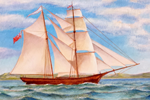
1. That by desire of Thomas Joseph Vecchio Esqr Marshal of this Hon Court in company with him and Fredk. Solly Flood Esqr H. M's Advocate General for Gibraltar and Proctor for the Queen in her Office of Admiralty on Monday the 23rd day of Decbr last went on board a vessel rigged as a brigantine name unknown supposed to be the Mary Celeste then moored in the port of Gibraltar and under an arrest in pursuance of a warrant out of this Hon Court as having been found derelict on the high seas and I then carefully and minutely surveyed and examined the state and condition of the said vessel and was occupied therein for a period of five hours.
2. On approaching the Vessel I found on the bow between two and three feet above the water line on the port side a long narrow strip of the edge of one of her outer planks under the cat-head cut away to the depth of about three eighths of an inch or about one inch and a quarter wide for a length of about 6 or 7 feet. This injury had been sustained very recently and could not have been effected by the weather and was apparently done by a sharp cutting instrument continuously applied thro' the whole length of the injury.
3. I found on the starboard bow but a little further from the stem of the Vessel a precisely similar injury but perhaps an eighth or a tenth of an inch wider wh. in my opinion had been effected at the same time and by the same means and not otherwise.
4. The whole of the Hull--Masts Yards and other Spars were in their proper places and in good condition and exhibited no appearances whatever that the vessel since she had undergone her last repairs or during her last voyage had encountered any seriously heavy weather. Some of her rigging was old but some of her ropes appeared to have been new at the commencement of her last voyage.
5. The peak halyards and throat halyards appeared to be the same with wh. she had been rigged during her last and more than once previous voyage. None of them had been recently spliced and they were all in good working condition. If the peak halyards had been carried away during her last voyage they must have been subsequently spliced wh. was not the case.
6. If the peak halyards had been carried away while the vessel was under sail and the vessel had been abandoned hurriedly and without letting go the throat halyards the gaff would have been carried backwards and forwards by the wind. The jaws of the gaff would thereby have been destroyed and the mainmast would have been cut into but the jaws of the gaff exhibited no signs of an [sic] recent injury and the mainmast was undamaged in such a case also the Gaff would have ripped the mainsail to pieces.
7. Moreover the main boom would have swayed backward and forward and in the event of there being any strong wind either the sheets would have been carried away or the bolts wld. have been torn out of their deck but they were all uninjured--
8. Upon examining the deck I found the butts and waterways in good condition the pitch in the water ways had nowhere started wh. it must have done extensively if the vessel had encountered seriously bad weather.
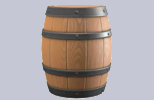
9. The Vessel had not bulwarks but was provided with a top gallant rail supported by wooden staunchions [sic] the whole of wh. were uninjured nor was there a single stanchion displaced. The water barrels on deck were in their proper places and secured in the ordinary manner but such that if the vessel had ever been thrown on her beam ends or encountered a very serious gale they wld. have gone adrift and carried away some of the stanchions of the top gallant rail.
10. Returning to the bow of the Vessel I removed the forehatch immediately under wh. was a new hawser wh. had never been used and was perfectly dry - Had any quantity of water found its way thro' this hatch the hawser would have exhibited signs of having been wetted. It exhibited none nor did any other of the articles wh. I observed there.
11. I found a forward deck house thirteen feet square and about six feet in height above the deck.
12. The deck house was made of thin planking painted white the seam between it and the deck being filled in with pitch a very violent sea would have swept the deck house away. A sea of less than very great violence would have cracked the pannelling [sic] and cracked or started the pitch through-out or at least in some parts of the deck.
13. It had not suffered the slightest injury whatever there was not a crack in the planking nor even in the paint nor in the pitch of the deck seams.
14. The port side of the deck house was divided into two cabins the forward one extended between nine feet six and ten feet across the deck and about six feet nine inches fore and aft the after cabin being on the same side was about six feet nine inches by six feet nine inches. The forward cabin entered by a sliding wooden door facing the bow of the ship.
15. Close in front of the door of the forward port cabin was a seaman's chest unlocked and at the sides of the door opposite to it was another also unlocked. Both were quite full of seamen's effects of a superior description and mostly quite new. They were perfectly dry and not had the slightest contact with water.
16. Amongst the articles I observed in one of them was a new cigar case with metal clasp not in the slightest degree rusty. It contained nothing but 3 gold studs set with precious stones and a razor also equally unaffected by water. I also particularly noticed a pair of new instep boots and a pair of new high foul weather boots both perfectly clean a quadrant in its case together with a piece of chamois leather all perfectly dry and uninjured and unaffected by water.
17. I also carefully searched for marks of mildew on all the articles particularly on the boots and the rest of the clothing but could not discover any or any other mark of water wh. I believe I must have discovered if the Vessel had encountered any very bad weather.
18. I then examined the after Cabin on the port side wh. I believe to have been the second Mate's and it contained a seaman's chest similar to those in the forward port Cabin and containing clothes wh. I carefully examined but none of which exhibited the slightest appearance of having been subjected to water.
19. The sills of the doors of these Cabins rise to the height of about a foot above the deck. If water had come into either of them to an extent to have flooded them an inch in depth a great part of the clothing wh. I observed would have shown signs of the water none of wh. were to be seen.
20. The Starboard Side of the Deck house to the extent of about six and a half feet in width aft and about 3 1/4 feet forward comprised the ships galley and was entered by a sliding door on the after side.
21. The stove and cooking utensils were in good order and exhibited no appearance of having suffered from exposure to water. Had any quantity of water found its way into the galley it would have immediately passed out thro' a scuttle hole on a level with the deck near the stove or thro' a hole wh. I found in the deck near the hearth into the hold.
22. The forward deck house was lighted by two windows on each side those on the port side were covered by a thin sliding shutter. The after window on the Starboard side was uncovered.
23. None of the shutters or of the windows were injured in the slightest degree. Some of them must have been greatly injured or wholly destroyed if the vessel had experienced very bad weather.
24. On the upper deck of the deck house I found the remains of two sails wh. apparently had been split some time or another in a gale and afterwards cut up as large lengths had been cut off with a knife or other sharp instrument and I subsequently found what I believe to be portions of those sails - subsequently found what I believe to be portions of those sails --
25. On going aft I examined a skylight wh. lights both the main cabin and the Captain's cabin. It consisted of six panes of glass on each side the whole of which had a small piece wanting. Had the ship experienced very bad weather the skylight unless it had been covered which it was not when I surveyed the vessel would have been greatly damaged.
26. The height of the Cabin is increased by means of a false deck raised about 15 inches above the deck of the vessel.
27. The entrance to the Cabin is by means of a companion through a door in the forward side and a sliding hatch.
28. On descending into the main Cabin I found at the foot of the companion an oblong piece of canvas wh. I believe to have formed part of one of the sails which had been split and which I had noticed on the forward house. It had been cut and fitted as a lining for a small recess to which it was carefully fastened with nails or screws and through a small brass hook apparently intended for the purpose of hanging a towel on had been carefully driven into one of the uprights.
29. This piece of canvas had evidently been fixed there before the vessel had sailed on her last voyage. On the port side of the main-cabin was the pantry entered by a door the sill of which was about an inch and a half above the level of the lower deck or floor of the cabin. On the floor of the cabin I found among other things an open box containing moist sugar a bag containing two or three pounds of tea an open barrel containing flour and open box containing dried herrings; also some rice a nutmeg some kidney beans together with several pots of preserved fruits and other provisions in tins covered with paper. The whole of these articles were perfectly dry and had not been in the slightest degree injured or affected by water.
30. On the plate rack was another piece of canvas apparently cut from off the sails which I had observed on the forward house. It was cut into the shape of a towel for which it was apparently used. On the Starboard side of the main cabin was the chief mate's cabin, on a little bracket in which I found a small phial of oil for a sewing machine in its proper perpendicular position a reel of cotton for such a machine and a thimble. If they had been there in bad weather then they wld. have been thrown down or carried away.
31. The chief Mate's bedding was perfectly dry and had not been wetted or affected by water. Underneath his bed place were the vessel's ensign and her private signal W T. The latter had been altered since it had been used. The letter W having been quite recently sown [sic] on.
32. I also found under the mate's bedplace a pair of heavy Seamen's boots for stormy weather greased cleaned and apparently unused and also two drawers containing various articles.
33. In the lower drawer were a quantity of loose pieces of iron and two unbroken panes of glass which wd. have been broken to pieces had the Vessel encountered any seriously bad weather.
34. In the lower drawer were among other things a pair of log sand glasses and a new log reel without any log line.
35. The whole of the furniture and effects in the cabin were perfectly dry and in good condition. None of the articles had been or were injured or affected by water.
36. In the cabin was a clock without hands and fastened upside down by two screws or nails fixed in the woodwork of the partition, apparently some considerable time previously.
37. On entering the Captain's cabin which is abaft the main cabin I observed and examined a large quantity of personal effects.
38. In the centre of the cabin against the partition was a harmonium in very good condition and near to it a quantity of books mostly of a religious kind and which with the exception of a few which I was informed by the Marshal had been removed by him out of the lowest drawer underneath the Captain's bedplace and which were damaged by water were in Excellently good condition.
39. I found also on the floor of the cabin a little child's high chair in perfectly good condition a medicine chest containing bottles and various medical preparations in good condition.
40. The whole of which articles were uninjured and unaffected by water.
41. The bedding and other effects were perfectly dry they had not been affected by water and were in good condition.
42. I am of opinion that some not large quantity of water had fallen on the floor of the cabin through the sky light and found its way into the bottom drawer under the captain's bedplace.
43. In the cabin I found one of the Vessel's compasses belonging to the binnacle. The card of it had been damaged by water.
44. I also observed in this cabin a Sword in its scabbard which the Marshal informed me he had noticed when he came on board for the purpose of arresting the vessel. It had not affected by water but on drawing out the blade it appeared to me as if it had been smeared with blood and afterwards wiped. Both the cabins were provided with lamps to be lighted by means of petroleum. They and their glasses were uninjured.
45. On the port side of the Captain's cabin was a water-closet near the door of which opposite to a window imperfectly covered on the outside was hanging a bag which was damp and had evidently been much wetted by rain or spray or both coming in at the window.
46. I was informed by the Marshal that upon his going on board the Vessel for the purpose of arresting her he had found the bag full of clothes mostly belonging to a lady and extremely wet.
47. On the Starboard side of the cabins were three windows two of which intended to light the Captain's cabin were covered with canvas similar to that of which the torn sails were made and apparently cut from it the canvas being secured by pieces of plank nailed into the frame work of the cabin the third window intended to light the chief Mate's Cabin no appearance of having ever been covered and the glass was injured on the side of the Cabin facing the bow of the vessel was another window secured in the same manner and with the same materials as those intended to light the Captain's cabin.
48. On the port side there was a window which lighted the water closet. It was partially covered in the same manner as that last mentioned. There was a port for another window to light the pantry but it had been effectually closed up by a wood made to fit into it.
49. Returning to the deck I found one of the pumps in good order the valve of the other had been removed for the purpose of passing a sounding-apparatus into the well.
50. The sounding apparatus wh. consisted of a metal bolt attached to a line was lying near & was in good order.
51. I then carefully examined the binnacle which I found secured to the deck of the cabin between two battens the original batten on the Starboard Side had been replaced by another roughly made. It was farther secured by cleats on each side.
52. The binnacle was constructed to hold two compasses and a lamp between them with a pane of glass separating the lamp from each compass. Both these panes of glass were cracked perpendicularly and apparently from the heat of the lamp only.
53. One of the compasses was in good working condition and did not appear to have been otherwise during the voyage. The other was missing being the one which I found in the Captain's cabin.
54. The binnacle itself did not appear to have sustained any damage.
55. In my opinion it never could have been carried away by a sea which wd. not have destroyed it & washed it overboard.
56. Such a sea wd. also have swept the decks and carried away the skylight off the cabin the top gallant sail & stanchions and besides doing other damage probably have thrown the Vessel on her beam ends.
57. The whole appearance of the Vessel shows that the Vessel never encountered any such violence.
58. I next examined the after or lazaret hatch which is secured by an iron bar and went into the after hold.
59. I found here barrels of stores and other provisions in good order & condition & in their proper places. The whole of these wd. have been capsized if the Vessel had been thrown on her beam ends or encountered any very violent weather.
60. I also saw there a barrel of Stockholm tar standing in its proper position with the head of the barrel off., none of it appeared to have been used. Had the Vessel encountered any very heavy weather this barrel wd. have been capsized or at all events some of the tar wd. have been spilt, but not a drop of it had escaped.
61. I found no wine or beer or spirits on board. I made the most careful & minute examination through every part of the Vessel to which I had access to discover whether there had been any explosion on board & whether there had been any fire or any accident calculated to create an alarm of an explosion or of fire & did not discover the slightest trace of there having been any explosion or any fire or of anything calculated to create an alarm of an explosion or of fire.
62. The Vessel was thoroughly sound staunch and strong & not making water to any appreciable extent.
63. I gave directions to Ricardo Portunato an experienced Diver minutely & carefully to examine the whole of the hull and bottom of the said Vessel her stem, keel, Sternpost & rudder while I was engaged on board in surveying her, and he remained under water for that purpose for a time amply sufficient for that purpose.
64. I have now perused and considered the paper writing marked A produced & shown to me at the time of the swearing this my affidavit & which purports to be an affidavit by said Ricardo Portunato in this cause on the 7th day of Jany. now instant.
65. Having carefully weighed & considered the contents thereof & all & singular the matters aforesaid I am wholly unable to discover any reason whatever why the said Vessel should have been abandoned.
